Thursday, December 6, 2012

Apple pie in the desert


Apple pie

In the middle of the desert at a reststop called Solitaire there is a bakery, Moose McGregor's desert bakery. This bakery specialized in, of all things, apple pie.


The pie itself is fantastic, not too sweet with a delicious crumb topping.  Each pie is 4.5 kg and can feed 10 people.  The bakery can sell up to 200 kg of pie on a good day.  If you're ever driving from Swakopmund to Capetown, you need to stop here.


The living desert, Swakopmund, Namibia


The Living Desert - Swakopmund, Namibia

There is a great company in Swakopmund called Living Desert Adventures that gives guided tours on the ecology of the dunes. They advertise seeing "the little five", snakes, scorpions, lizards, geckos, and spiders. I of course jumped at the opportunity to learn more about the desert.

When Chris, the owner of the company, picked me up that morning I was struck by his enthusiasm. So often in Africa I go on these tours and the guides just don't seem to care. His excitement made me even more excited for the day.  The rest of the tour group consisted of americans and canadians. It was really nice being with my own kind for the morning.

Chris is a passionate environmentalist and has fought for years (and suceeded!) to outlaw offroad quad biking in Namibia. Quad biking has a huge environmental impact and will kill and drive wildlife from the dunes. It took him over a decade, but now there are well established protected areas in the dunes and the wildlife has returned.

The yellow dunes outside Swakopmund are the only ones in the world that have a grey sky every morning.  The air coming off the ocean smells so clean and the air is moist, for a desert.  Succulents that look like jade plants pepper the landscape. These plants can hold a lot of water, which Chris demonstrated by squeezing some of the leaves. The leaves have a high salt content and are not good to eat. I was surprised over the amount of water that was squeezed onto the sand since there hadn't been a proper rain in 21 months.

Dunes are made of shifting sand. They can move at a speed of 3 m/year. The side not facing the wind sits at a 35 degree angle, which is the degree at which the sand begins to run.  In these protected areas bits of plant matter collect, providing food for the beetles, which feed the snakes, skinks and geckos, which feed the jackals and the birds, and so forth.

The most amazing part of this tour is that nothing is immediately present on the sand. Chris would walk up to a sand dune that had a completely flat expanse and start digging. He would then pull all manner of creatures out of the sand.


The first creature was a dancing white lady spider.  They are a type of trapdoor spider and usually nest at the top of the dunes. If a predator comes to eat them, they will drop along the dune, spinning the entire time, and will land in a ninja position. Hence the dancing name.  The spider we found ended up biting Chris as he was taking its picture.

Next up was the Namibian Dune gecko. This may be one of the most beautiful lizards I've ever seen. It has a stunning rainbow appearance, with pinks, yellows and blues present on the body against a white background.  They are nocturnal and have huge eyes. In addition, the gecko has 4 webbed feet which help with digging and not sinking into the sand. Just like snow shoes.


After 3 tries, Chris finally managed to grab a legless skink. They move very fast through the sand, like water.

Shovel nosed lizards move opposite in response to hot sand.

Tenebrionid beetles are everywhere.  They have very long legs which hold them above the ground. This small difference reduces the temperatures they are exposed to by 15 degrees.

We didn't find any snakes, specifically the side winder adder. But we did see tracks left by one.  They sit under the sand with only their eyes protruding, waiting for prey. They will also wiggle the tip of their tails to attract prey to within striking distance.

Finally, we found a desert chameleon.  They are different from most because they prefer life on the ground, not in trees.  The female we found started as a nice white color but as she grew more stressed darkened to a charcoal grey. Chris baited her with a mealworm and she climbed right onto his hand. He gave a feeding demonstration. Her tongue could stretch so far!


Afterward the animals we had a scenic tour of the dunes.


I would highly recommendthis tour to anyone visitng Swakopmund, even if you aren't a biologist. It was fantastic.

Sandboarding- Swakopmund, Namibia


Sandboarding - Swakopmund, Namibia

The town of Swakopmund has been described as Germany in the desert. There is a strong german influence on food, architecture and culture. The town does not feel like Africa to me.

On the outskirts of the city along the coast of the Atlantic Ocean are giant dunes. They are huge, in some cases rising several hundred feet. They put the dunes on the cape to shame.

There are two options for sandboarding. You can stand up on the board and go down the dunes like a snowboarder.  The second is to lie down on the board and essentially sled down the dunes.  I opted for the second option since the last time I tried to snowboard I ended up in the emergency room.

At the base of the dunes we were given out gear: a helmet, gloves, elbow pads and a board. The board was literally a sheet of pliable particle board, like you have on the back of cheap wood furniture. I had expected a more substantial sled.  The climb to the top of the dune was hard work. Walking in the sand is difficult enough, never mind climbing the side of a dune. Stepping into the footprint of the person who went before you helped.

The first run was scary. It's steep! Way steeper than it looks. And they expect you to slide down head first on a bit of board... hmmm... not sure how I feel about this.  I choked onmy first run, allowing the front of the board to drop into the sand and kicking up a ton of sand into my face. I swallowed a large portion of the desert. Bleh. The sand coated my face, giving me the appearance of a beard.

The next run was the easier of two courses, dizzie and lizzie. How appropriate. I was feeling a bit more confident, although this one was a lot steeper and longer.  One of the guys supervising had a speed detector. I hit 54 km/hr. It felt like I was flying. Thankfully the sand provides a soft landing. Dizzie has a small jump that will make you go airborne if you hit it just right. I did. I also clocked in at 69 km/hr, which is about 45 mph.


Saturday, December 1, 2012

Skydiving, Swakopmund, Namibia

Today I fell in love. Not with a boy, no no, with skydiving.  I made the decision to jump about 2 weeks ago. Our driver, Tim, is obsessed and convinced me. Honestly, it wasn't too hard. After watching Jordan and Kirsty bungee off the Vic Falls bridge, I wanted to do my own big adrenaline activity.

I was surprised I was so calm through the whole experience. I was never really scared at all, just excited. That's big for me. As most of my friends I've had for a while know, nerves usually makes me stop eating. I had no trouble eating some instant noodles for lunch today, only hours before the jump.

My skydiving master was named Chris and he was a blast. He pointed out the salt pans and the dunes as we flew over them. At 10,000 feet I scooted my feet over the edge of the open side of the plane and jumped. My scream was not one of terror, but rather exhilaration. Wow. After about 30 seconds of free fall we were gliding over the desert of Namibia, ocean in the background. I was shaking from the adrenaline.

Today I flew like a bird, and it will not be my last time.

Friday, November 30, 2012

Cape Cross Seals


Cape Cross, Namibia

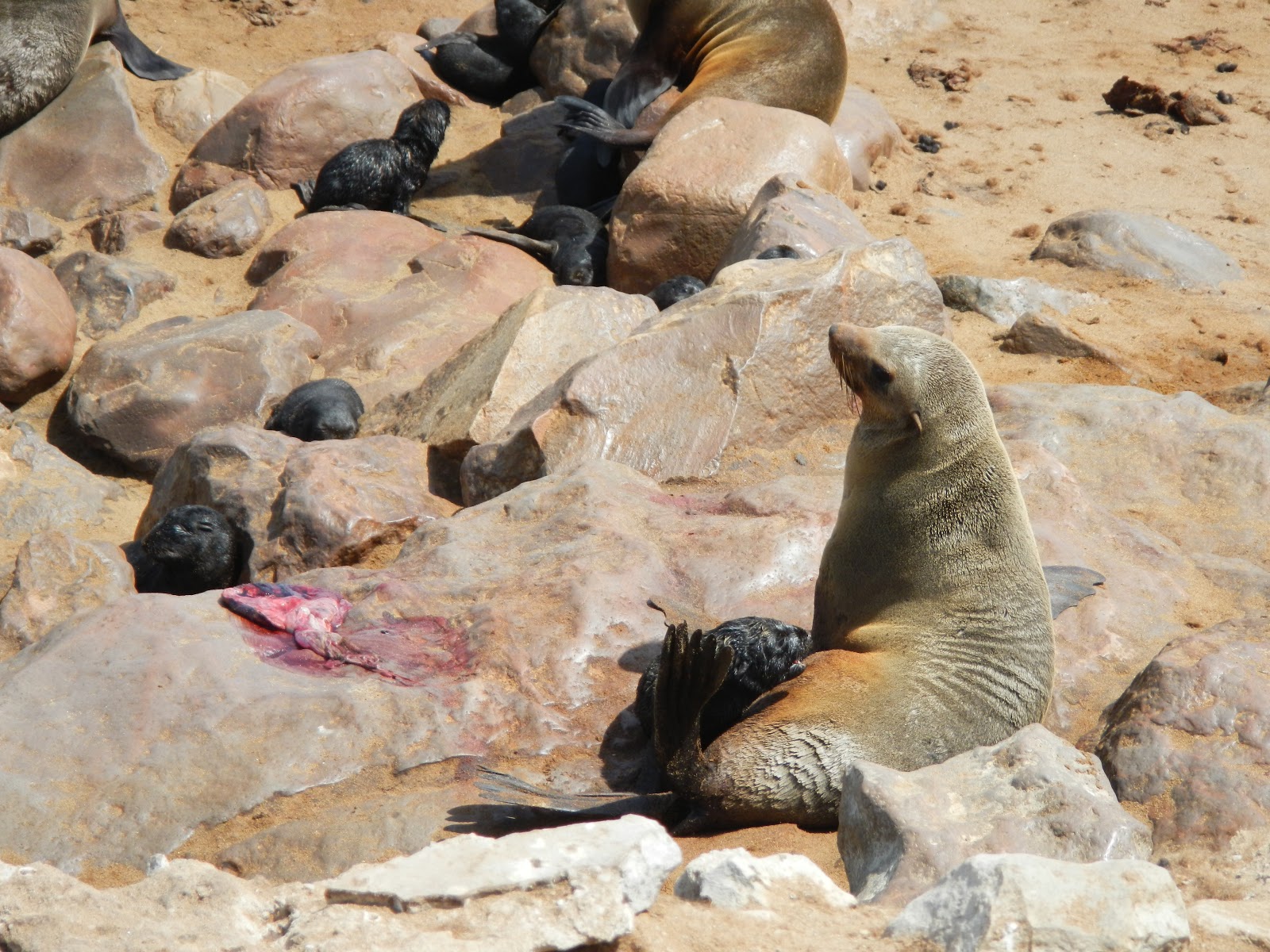
On the coast of Namibia is a gigantic colony of Cape fur seals.


October to November is mating season, so I got to observe the colony in full swing.  Females were giving birth, males were fighting for the right to mate with females.  It was quite a show and the seals were making a lot of noise.

A Female with a new born pup. Note the afterbirth on the rock to the left.
I must warn you if you ever decide to see this biological wonder. The seals smell TERRIBLE. You may think I'm being overly dramatic or that I am sensitive to odors. I can assure you that is not the case. The smell is so strong it sticks to your hair and clothes and most people watching the seals are also holding their noses.

Brandberg, Namibia

Brandberg and the surrounding desert is well known for its archaeological sites.  I was given the opportunity to visit the Brandberg National Monument and observe one of its most popular attractions, The White Lady.


To get to the site with the cave paintings you have to walk 2.5 km. Piece of cake, right? Not so much. We started our hike at 1pm in the middle of the Namibian summer.  The temperature on the flat hike was over 40 degrees C, over 100 degrees F.  I don't think I've ever been so hot in my life. It was the hardest 5K I've ever done.  Was it worth it? Definitely.
The cave paintings

The White Lady cave painting was discovered in 1917 and is estimated to be over 1000 years old.  The central figure in the cave painting was misidentified as a white woman, indicating that the natives were aware of white men hundreds of years before the first records.  However, this was incorrect.  The figure is a medicine man.  Occasionally these men would paint themselves with white clay in religious rituals, which is how the man is depicted in the cave painting.
The White Lady


Wednesday, November 28, 2012

Cheetah Park, Namibia

There is a rescue organization for cheetahs in Namibia called Cheetah Park. There is a hug problem with cheetahs hunting livestock. It is not illegal to shoot and kill a cheetah in Namibia.  This group takes the cheetahs in so they aren't killed.
Who could hurt this face? 6 month old cub

There are 3 adult cheetahs that roam the grounds. They are friendly and you can pet them. The fur is really thick and they purr very loudly.

We were given the opportunity to watch the cheetahs feed in the evening. We didn't see them run, but we did see them jump. They are amazingly agile creatures.